

Anishinabek Nation Grand Council Chief offers thoughts on proposed legislation
By Sam Laskaris
CHIPPEWAS OF RAMA FIRST NATION – An early look at a proposed federal bill was not met favourably by Anishinabek Nation Grand Council Chief Linda Debassige.
The Government of Canada introduced Bill C-37, An Act respecting water, source water, drinking water, wastewater and related infrastructure on First Nation lands, or First Nations Clean Water Act, for short, on June 16. As per the House of Commons website, “This Act affirms that the inherent right to self-government, recognized and affirmed by section 35 of the Constitution Act, 1982, includes the jurisdiction of First Nations in relation to water, source water, drinking water, wastewater and related infrastructure on, in and under First Nation lands. It sets out principles, such as substantive equality, to guide the provision for First Nations of clean and safe drinking water and the effective treatment and disposal of wastewater on First Nation lands. It provides for minimum standards for water quality and quantity and wastewater effluent. It also provides pathways to facilitate source water protection.”
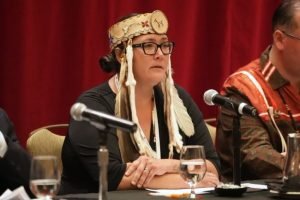
The Bill was introduced in the House of Commons and received its First Reading that day. That same day, Grand Council Chief Debassige was in Chippewas of Rama First Nation attending the Chiefs of Ontario Annual Chiefs Assembly, where she participated in a press conference to offer her initial thoughts on the proposed Bill.
An earlier attempt to pass a similar bill when Justin Trudeau was the Canadian Prime Minister had been first introduced in December of 2023, as Bill C-61; however, that did not become law due to the prorogation of Parliament in January of 2025.
The current government, led by Prime Minister Mark Carney, has reintroduced the proposal as Bill C-37.
During the June 16 press conference, Grand Council Chief Debassige said Anishinabek Nation officials are reviewing the Bill.
“Unlike previous legislative efforts, which were developed through meaningful dialogue and partnerships with First Nations Knowledge Keepers, Bill C-37 was introduced without broad or meaningful input by First Nations,” she said. “Former Bill C-61 was a result of two years of co-development and over two decades of advocacy.”
Grand Council Chief Debassige is hoping federal officials get things right with this Bill.
“Water is a human right,” she said. “We are looking to Canada to help us champion a shift from the outdated and colonial perspectives of First Nations being viewed as second-class citizens to ensuring our people can enjoy the same clean and safe drinking water guarantees as non-First Nations across this country.”
She added she’s hoping federal officials do end up asking for First Nations’ input.
“As we see this Bill move its way through the legislature and likely be given to committee to study, there must be sufficient engagement with First Nations, our rights holders, our Nations who have inherent jurisdiction, First Nations governance structures, Traditional Knowledge Keepers and community voices,” she said. “Not including or engaging with these critical figures undermines the principles of self-determination and respect for First Nations sovereignty.”
Grand Council Chief Debassige also said she is troubled by the fact that First Nations’ inclusion has not already transpired with this Bill.
“This is concerning, particularly for a piece of legislation that is in part about affirming First Nations constitutionally protected right to self-government,” she said. “Regarding the topic of the legislation, the shortfall must be rectified and remedied. As the Bill moves through the process, we also must remember that the drafters of Bill C-37 most often have never spent time in any of our communities and also remember that governments over time have neglected their fiduciary duty. Yet they continue to make policies, rules for us, without us.”
Grand Council Chief Debassige also said not having a transparent consultative process diminishes the legitimacy and effectiveness of the legislation.
“When government prepares legislation without us, it signals to our Nations that the government is only interested in protecting themselves,” she said.
Grand Council Chief Debassige is hopeful federal officials will take the necessary steps to correct water issues on First Nations.
“We can’t keep stalling and avoiding taking steps that address the problems First Nations have had to deal with for way too long,” she said. “We do, however, look forward to working with Prime Minister Carney’s Liberal government to strengthen this legislation that will meet our Nation’s needs and remain hopeful that this legislation sets the stage with which affirms First Nations inherent rights to exercise First Nations jurisdictions in their lands.”