

First Nations artist creates Google Doodle for National Indigenous Peoples Day
By Sam Laskaris
AAMJIWNAANG FIRST NATION – Nico Williams was understandably overwhelmed by his most recent accomplishment.
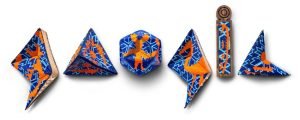
Williams, a citizen of Aamjiwnaang First Nation in southwestern Ontario, was chosen by Google to create a Doodle to be displayed on its home page on June 21, for National Indigenous Peoples Day.
Google Doodles are temporary, artistic adaptation, including static illustrations, animations, slideshows, videos, and interactive games, of the Google logo on its homepage to celebrate a range of topics ranging including holidays, anniversaries, and trailblazing individuals who have impacted culture.
Williams’ Doodle was inspired by Anishinaabe iconography and the Great Lakes region. He sculpted the letters of the Doodle in deep blue and navy, to signify the abundance of fresh water across Indigenous territories.
“It was sort of unbelievable when I first got asked by Google to weave sculptural letters made of beads for the June 21st celebrations,” Williams said.
He said he was contacted by a Google official about three months ago to create the piece.
“This got me really excited,” he said, adding he knew it was the 30th anniversary of the day, which was previously called National Aboriginal Solidarity Day.
Williams, who is 36 and now living in Montreal, recalled that when he was younger, members of his First Nation would receive a blue T-shirt to wear in honour of the day.
“It was fun to be weaving something 30 years later for the upcoming Indigenous Peoples Day in Canada,” he said. “But I also wanted to, like, really celebrate the vibrant histories, the Anishinaabe and the Indigenous people across Canada.”
Williams graduated with a Master of Fine Arts in Sculpture degree from Montreal’s Concordia University in 2021. That same year, he was awarded the prestigious Claudine and Stephen Bronfman Fellowship in Contemporary Art. This fellowship recognizes grads from the Concordia program, providing financial support and recognition of their work.
Williams’ artwork centres around sculptural beadwork.
“This Google Doodle is a really exciting thing to really share Anishinabek history with people, to be sharing that appreciation for water, to really bring out vibrant colours that are exciting to use with glass cylinder beads,” Williams said. “I’m just excited for people to appreciate beadwork and really look at the beautiful things that we make.”
Williams is also pleased to be doing his best to educate others about National Indigenous Peoples Day.
“It’s great to have it being recognized on a broader sense, to be sharing our cultures with each other, to be able to explore these narratives,” he said.
Williams added that always wasn’t the case, as in the past, many First Nations people were confined to their reserves.
“They weren’t allowed to go out and study without permissions from an Indian agent,” he said. “So, this feels pretty radical being able to do this and share this with people across the country.”
Williams was also blown away knowing just how much of a reach his Doodle would have.
“I think it will be on every single computer across Canada that day, so maybe millions [will see it],” he said.
While the exact number of Canadians who saw Williams’ Doodle is not certain, Google searches typically answer an average of more than 16 million questions each hour.
“That’s why I felt it was so unreal when I was first contacted by Google to do something,” Williams said. “But I was so excited to be sharing this practice of beadwork. I also got to throw in a bit of birch bark in there with some quills to pay homage to that connection, to those quill box-making that were done in like centuries ago up until now. So, it was exciting to bring in quill work with beadwork and show how it’s done in a contemporary way. I’m really excited to be sharing these sculptures with the Nation.”
Williams’ work has also been shown at various Canadian and American locations, including the Art Gallery of Hamilton, Regina’s MacKenzie Art Gallery, Musée d’art contemporain de Montréal, Musée des beaux-arts de Montréal, PHI Foundation for Contemporary Art, which is also in Montreal, and at the Center for Curatorial Studies Hessel Museum of Art, located at New York’s Bard College.