

Nipissing First Nation holds Zaagidwan Community Walk to say no to drug dealers
By Kelly Anne Smith
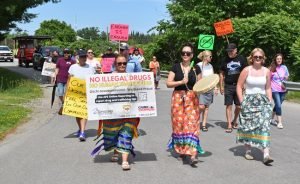
NIPISSING FIRST NATION — Holding posters saying, ‘We stand together against drugs’, ‘Drug dealers are not welcome’, and ‘Save lives, stop drug trafficking’, Nipissing First Nation citizens and leadership walked together in Garden Village on July 5.
Megan Bellefeuille, who helped organize the walk, explains that the name Zaagidwan means with love. Bellefeuille says personal experience is why she walks against drugs.
“We have so many community members and loved ones right now who are struggling. We need to approach this differently. We have our Band-Aid solutions—but those are temporary solutions; we don’t have anything long-term to bridge the gaps. We need to look at new ways to help those who have found themselves on this path. We want to do this with love and remind people they can heal,” explains Bellefeuille. “…I agree with harm reduction responses. I’m not going to say no one gets better, but it’s very hard to come out of. And it’s not just a community issue—this is a Canada-wide issue. I say that because I have travelled internationally, and certain countries look different than Canada right now….I’m a community member. So, I’m hoping maybe my one voice will help echo and reach higher-ups. I don’t know at this point. And I don’t know what the solution is. Something has to happen. Something has to change.”
Bellefeuille says that they are all family in Nipissing First Nation.
“These are all aunties, uncles, brothers, sisters—we need to all come together. The Chief and Council and the [Anishinabek Police Service] are all in support of this. Let’s heal. How can we convince you to come and heal? This is not acceptable for our children to see. By us not saying anything, it’s also saying it’s acceptable. I can’t just sit here and say nothing and normalize this for my children.”
A young girl proudly wears the police badge of Anishinabek Police Service Sergeant Chantal Larocque as they ready for the walk. Sergeant Larocque talks about a recent warning of dangerous drugs.
“Just a while back, Anishinabek Police Service posted about a batch that was very worrisome in regards to an increase in overdoses. This walk is important. As I look at my special agent wearing my badge right now, it’s about her. This shouldn’t be normalized,” she says. “I get what is trying to be done and APS is definitely making a lot of headway, but we still need more help from the public, hence the signs that have the online reporting option if you are not comfortable using Crimestoppers or not comfortable calling the dispatchers. We are only as good as the information we get, so police are only as good as the information received by the public. That’s why it’s so important to come and collaborate together to get on top of this.”
Nipissing First Nation Councillor Samantha Stevens says taking a stand against drugs is crucial to the community.
“As a councillor, it’s important for me on a political level to make decisions that keep our community safe. And on a personal level, it’s important to me because I’ve been in recovery for almost nine years now. Even in the last nine years, a lot has changed with the drugs. We have to stop calling them overdoses. We have to call them what they are; they’re drug poisonings. People are using one time and they’re dying.”
Councillor Stevens says the community wants to be involved in banning drugs from Nipissing First Nation.
“There’s a lot of political things that can be done in administration, but the community also wants to be heard. A lot of our family members are being affected by drugs, whether it be directly or indirectly…We’re not here to shame anybody. We’re just here to show the community that we do care for all of our community members. The drug dealers are not welcome.”
Councillor Stevens highlighted that in January, Chief and Council signed a memorandum of understanding with Crimestoppers.
“We’re offering up to a $10,000 reward for hints that lead to drug trafficking on our First Nation. So, we’re encouraging all of our members to use the Crimestoppers anonymous reporting. If you see it, report it.”
Councillor Stevens says Nipissing First Nation has resources for people to learn about the symptoms of drug use.
“A lot of people don’t know what the signs are to look for. We’re here today to show people all of those programs and resources that we have, so we can work as a community together to heal our people. To heal all of us.”
Nipissing First Nation Gimaa Cathy Stevens is pleased with her community for coming together to send the message that drug dealers are not welcome.
“Council supports all of this. We’re on board. As you can see, council members are here. We’re making sure it all happens. This is a step forward with the community coming together and saying we don’t want this anymore. We want to help people and make things better.”
After the Zaagidwan Community Walk, members gathered for a barbecue at the Garden Village Community Centre.