

Pays Plat First Nation hosts Anishinaabemowin Immersion Summer Camp
By Rick Garrick
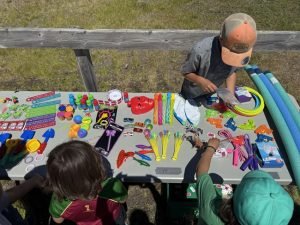
PAYS PLAT FIRST NATION — The Superior-Greenstone District School Board (SGDSB), Superior North Catholic District School Board (SNCDSB), and Anishinaabemowin Boodawe Committee recently held an Anishinaabemowin Immersion Summer Camp from July 6-10 in Pays Plat First Nation.
Another Anishinaabemowin Immersion Summer Camp is also scheduled for July 13-17 in Ginoogaming First Nation.
“This week, we are in Pays Plat First Nation and next week we’ll be in Ginoogaming First Nation, and through the entire process, we work with fluent speakers and hire them on, so we have eight fluent speakers with us in the camp who are leading the children in learning the language,” says Shy-Anne Bartlett, manager of Indigenous education at SGDSB. “We’re doing it in small groups, with two language speakers with each small group so that the students can hear how the language sounds between people, how it’s supposed to actually flow when spoken in a fluent setting.”
Bartlett says they also have mentor learners, who are high school students or recent graduates of high school, at the camp.
“Their job is to learn Anishinaabemowin, and they have been hired to support the language speakers and the students,” Bartlett says. “The camp is geared for the primary students, so ages four to nine, but of course we allow kids in that are older and younger because language learning should be open to all.”
Logan Coaster, a mentor learner at the camp, says he is currently learning Anishinaabemowin under the Anishinaabemowin Boodawe Committee.
“[The camp] is really fun, you get to teach kids [Anishinaabemowin],” Coaster says. “I learned from my teachers from my school, Geraldton Composite High School, and one of the teachers asked if I wanted to become a student in this program. In the summers, I get to go to these camps.”
Rex Bartlett, a young helper at the camp, says it is cool to see the students learning Anishinaabemowin.
“And I’m also learning a bit, too,” Rex says, noting that he began learning Anishinaabemowin about six years ago when he was four years old. “When I was four, I didn’t know much but now I know how to count to 100, I know a whole bunch of different animals and colours and stuff like that. I don’t really know how to do sentences but I’m learning that.”
Andrea O’Nabigon, a language speaker from Long Lake #58 First Nation, says the camp is an immersion camp so they are only supposed to speak Anishinaabemowin.
“We have to pause and repeat words and take our time because the students will pull our shirts and say, ‘Hey, I don’t understand,’” O’Nabigon says. “So, we have to try to put our students in the setting where there’s more activity and hand motions and songs and culture, like learning about the zhiishiigwan. Yesterday, we made the zhiishiigwan, and that’s the rattle, and this morning, after we had the craft yesterday, we’re in the process of learning a song, the Turtle Song.”
O’Nabigon says it is important to be involved with the camp because they need to pass Anishinaabemowin on to their children, grandchildren, and other people.
“There is a great need, we are losing our language faster than anything else,” O’Nabigon says.
Tony Bouchard, a language speaker from Kiashke Zaaging Anishinaabek, says he learned Anishinaabemowin from his parents.
“My dad went to Residential School, my mom didn’t,” Bouchard says. “My mom’s parents took her to the bush and ran away and learned how to do all the stuff that Anishinaabe people did: fishing, hunting, doing all the Anishinaabe stuff they had to do, skinning, cooking all the wild game, and speaking the language.”
Bouchard says his father spoke Anishinaabemowin all the time because he knew it was important for them to learn their own language.
“So today, I’m into my culture, I love my culture, I’m proud I’m Anishinaabe, and I’m going to teach anybody that wants to learn,” Bouchard says.
Priscilla Fisher, a language speaker from Ginoogaming, says her grandmother would only talk to her mother in Anishinaabemowin, and her mother and father also taught her and her siblings Anishinaabemowin.
“I am very fluent in my language, I speak my language all the time because we were raised with seven brothers and three sisters,” Fisher says. “It’s an honour to be here, to know what these workers are doing here, what they’re doing with the children, and the children are wanting to learn. That’s all you need; it takes a whole community to raise a child.”