
Wasauksing First Nation citizen pens a children’s book about his family pet
Mangeshig Pawis-Steckley.
By Sam Laskaris
VANCOUVER — Mangeshig Pawis-Steckley is hoping a book he wrote about a feline companion he acquired early during the COVID-19 pandemic will be well-received.
Pawis-Steckley, who lives in Vancouver, British Columbia, picked up a cat he named Mooz, which is the Anishinaabemowin word for moose, while spending the summer of 2020 living with his mother in his home community Wasauksing First Nation.
“She was a part of a litter and was abandoned by their mother,” Pawis-Steckley said. “My cousin was giving away a bunch of cats. And I decided to take one.”
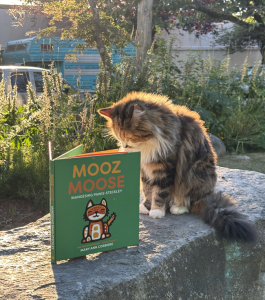
In honour of his cat, he’s written a children’s book titled Mooz Moose. The book, published by Groundwood Books, will be available on September 1 but can be pre-ordered online via House of Anansi.
Pawis-Steckley tells readers that Mooz doesn’t really look like a moose. He then proceeds to describe Mooz better. She looks more like a lynx. She’s as small as a marten. She races like a hare.
Besides English, the text in the colourful picture book is also in Anishinaabemowin. Thus, readers are learning new words including those of various animals.
“I thought it would be a good way to make comparisons and show the adverbs and prepositions within the language, and I guess different ways you can sort of create these sentences,” Pawis-Steckley said. “So, I thought it was a pretty fun book.”
Pawis-Steckley and Mooz have had their share of adventures.
“She lived with me for a bit in the summer (of 2020) and then I decided to make my way across Canada back to the west coast,” he said. “We kind of just camped along the way. I would take her outside during the trip and she would roam around. I had this like collar I got for her that was reflective so I could just flash a light and sort of find her.”
Mooz would run off at times, and he was forced to chase her down.
“For the most part, she learned to kind of stick around me,” Pawis-Steckley said. “And I sort of built this trust with her.”
In 2021, Pawis-Steckley took Mooz to an Indigenous blockade that was on Vancouver Island.
“She kind of got lost one of those nights and I thought she was lost for good,” he said. “I stayed an extra night and I could not find her. Usually she would come back within the hour. And she just never came back, so I figured she was gone for good.”
After Pawis-Steckleey returned to Vancouver without his cat, friends reported various sightings of Mooz near the blockade. And, as it turned out, a friend picked up Mooz and brought her to Vancouver to be reunited with Pawis-Steckley a couple of months later.
He added that he started dating the woman who is now his wife during the period his cat was missing.
“My wife likes to say that Mooz ran away so that I could focus more on finding her and not be so caught up in raising my cat,” he said.
Pawis-Steckley also explained how he named his cat.
“There was really no reason in particular that I named her Mooz,” he said. “I just like this word. I guess some friends had called me Moose back in the day, just in jest. I just thought it was a good name for her because she doesn’t really resemble a moose at all. And when I was thinking of this book, I kind of used that to sort of tell this story about why she was called a moose.”
Pawis-Steckley said there have been mixed reactions to his book in his household.
“I’ve showed her pages,” he said of Mooz. “I haven’t read it to her. She kind of sniffed at it. I put some treats on the cover. She ate some treats off the cover of the book. But I don’t think she realized it was her.”
Meanwhile, Pawis-Steckley said he’s read the book to his young daughter Mino-Margaret numerous times.
“She loves it,” he said. “She even has a cameo in the first spot illustration of the book. And she’s just super excited to have a book about her cat. She thinks it’s awesome.”