

Anishinabek Employment and Training Services hosts budgeting presentation
By Rick Garrick
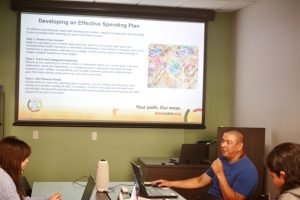
THUNDER BAY — Anishinabek Employment and Training Services (AETS) held a Budgeting presentation by Cheyenne Nobis on July 16 at its Park Avenue location in Thunder Bay.
Some of the topics covered by Nobis were why budget, understanding debt, spending behaviour, developing an effective plan, needs vs wants, and tracking spending.
“All of us have probably struggled at one point financially, and for me, the one thing I like to do is share my lived experiences if it’s something that relates to what I’m presenting,” says Nobis, Life Skills Officer at AETS and a Biinjitiwaabik Zaaging Anishinaabek citizen. “So, it’s just what I’ve learned and just sharing that knowledge and it’s something that even I’m still continuing to learn even though I’m doing this budgeting.”
Nobis adds that there have been requests to do budgeting presentations for community members who are receiving annuity payouts.
“People from the nine [AETS] communities want me to do budgeting for large sums of money,” Nobis says. “It’s just [to] give people that education and knowledge. People are going to do what they want to do with their money when they get it, so we’re just trying to spread that knowledge.”
Nobis says that during his presentation, he highlighted why it was important to budget, how to track spending, and the psychological aspect of why people spend.
“As I was doing my research for this presentation, that was something that I came across,” Nobis says. “There actually is a psychological aspect to it: people spend impulsively, people just feel that urge or they use it as a way to feel good — so that I thought was important to put in my presentation.”
Nobis kicked off his presentation by stressing how financial freedom starts with a plan.
“A budget is a financial plan that estimates your income, expenses, and savings over a specific period, helping you manage money more effectively and achieve financial goals for things such as paying your living expenses, paying off debts, saving money, decide what you can and cannot afford, meet your goals, set priorities, [and] adjust to changes that happen in life,” Nobis says. “A budget is essentially a plan that outlines how much money you earn, how much you spend, and how much you can save or allocate to different financial goals. It serves as a roadmap for managing your finances, allowing you to prioritize essential expenses, reduce unnecessary spending, and build savings for emergencies or future goals.”
Nobis says budgeting can help people to avoid overspending and going into debt.
“By setting limits on spending, budgeting helps prevent impulse purchases and unnecessary expenses,” Nobis says. “It also provides a structured plan to pay off debt, allowing you to become debt-free faster and avoid accumulating interest. A budget that includes an emergency fund ensures you are financially prepared, reducing stress, and preventing you from relying on credit.”
Nobis says budgeting can help people to achieve their financial goals, including saving for a home, vacation, or retirement.
“It keeps you on track and allows you to make steady progress towards long-term financial milestones,” Nobis says.
Nobis says he has been tracking his own expenses by writing them down on paper since the New Year, noting that he plans to continue for a full year.
“I literally go week-to-week and I keep track of my food, how much I spend, I keep all my receipts, and how much my groceries are — at the end of the week I tally up and it tells me how much I’ve spent,” Nobis says. “Whenever I gas up, I get the receipt, my laundry I’m keeping track of, and then I also keep track of miscellaneous stuff, like I have a Netflix subscription and I just buy the gift card of $30, I keep track of that. If I buy clothes for my son, that goes under miscellaneous; if I eat out, that goes under miscellaneous.”
Nobis says keeping track of his expenses helps him to budget better.
“It does help because I can see my numbers,” Nobis says. “I know what I spend on groceries, I know what I spend on gas, [and] I know what I spend miscellaneously.”
Aidan Johnup-Roach, one of the participants at the Budgeting presentation, says he learned about trying to keep track of all his expenses and any income he might have in order to help save better and to cut back on any expenses that he doesn’t need during the presentation.
“It was a good presentation; it was easy to follow through, he answered questions and was very interactive with us,” Johnup-Roach says.
John DeGiacomo, Executive Director at AETS, says they help people who need assistance, including life skills such as budgeting.
“When we do look at finances, it’s good to have a plan so that you’re prepared for unexpected things that come up, so this is where the Life Skills Officer will work with clients to make sure you talk about those unexpected things and prepare accordingly,” DeGiacomo says. “So, it may be putting x amount away every month to prepare for the rainy days that may happen or the unexpected expenses with vehicles or a renovation that is required.”
AETS highlights upcoming presentations and workshops on its Facebook page.