

Nipissing First Nation artist’s digital beads shine bright in Toronto mural
By Kelly Anne Smith
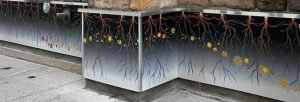
NIPISSING FIRST NATION — Nipissing First Nation artist Donald Chrétien has found a prominent canvas for his new work, Roots of Hope, which spans the exterior of the Church of the Redeemer.
Chrétien spoke about how he imagined the church as a medicinal plant that is putting roots down to grow.
“I was thinking of the Tree of Life, where it joins the earth with the sky. And I guess that would be the in-between parts to be the actual church in a physical sense.”
Asked how it feels to walk down Bloor Street and see his beautiful work of art, Chrétien said, “It’s weird.”
“You know when you do these drawings and then you actually see the final work, it’s a good feeling. When I was a student, when I went to the Ontario College of Art [and Design University] in the early eighties, I would have my Fridays off and eat my lunch on the steps of that church,” Chrétien said. “It’s kind of odd, being a student at that time, not realizing that eventually, I’d have artwork along the side of it, which is full circle.”
Seventy-five feet of the church’s lower 30 inches features Roots of Hope. Chrétien used a woodland beading technique that shines in the daylight and glows at night.
“It’s actually a technique I learned way back when I was doing commercial work doing corporate brochures and, on the cover, we were embossing and putting a clear [coating] only on the embossed areas. I wondered what that would look like if we put a clear [coating] over each bead, only over the beads, and the background is sort of a matte, so it doesn’t reflect. It’s a gradient like a drop shadow from the church being lifted up. And it worked out. We put a light on top of it, and we were all standing there going, ‘Wow’,” Chrétien said.
Chrétien designed the individual ovals of colour that he calls digital beads.
“Each one of those beads is one little vector drawing with the gradient inside it. I designed that, probably during COVID[-19],” Chrétien said. “Before that, I tried to do some beading myself and I’ve got really bad arthritis, and I just couldn’t do it. I was frustrated, so I went home, and I designed a digital bead. And I was doing plant medicines with that. I wanted to recognize what the actual plants were.”
The mural’s description reads: “We invite you to walk this path of beaded roots. They reach deep towards an ancient, buried creek. They spring from land lived upon by humans for 15,000 years: from the Huron-Wendat and the Petun, to the Seneca and the Mississaugas of the Credit River.” A video shows the beautiful meaning behind Roots of Hope.
The importance of plants often headlines Chrétien’s artwork.
“It’s that hierarchy thing where we think we’re the most important thing,” Chrétien said. “But on the triangle, plants are what supports everything —the animals and then us. So really, if the plants are gone, we’re gone. I really want to emphasize how important Mother Nature is.”
Chrétien points to his work helping city kids appreciate and see the beauty in the forest while he was teaching at the McMichael Gallery. Many of his projects have been creating dynamic trail markers to show the way for hikers. Chrétien also designed a 12-foot work of art, sculpted by Shane Clodd from a 200-year-old sugar maple that was struck by lightning at the Sharon Temple’s Hope & Truth Reflection Garden.
The artist also designed and built the Signature Planter Inaawanidiway, which translates to “they travel together,” featuring a canoe carrying a marten, crane, bear, and deer. The artwork is in East Gwillimbury and was created to honour Indigenous Peoples Day in 2022. Lauri Hoeg, a citizen of the Chippewas of Georgina Island First Nation, wrote the accompanying story.
In May, a University of Toronto reception was held where Chrétien spoke about his artful design for the Tree of Life, which displays donor names at the Indigenous House.
He is currently working on a medicine blanket modelled from a plant wheel gifted to him by Anishinabek Nation.
“You actually have a full circle of the year and a full circle of all the plants drawn in a bead work.”
Chrétien has recently been asked to create a 10 x 10-foot mural in a building that has just been completed for people who have been unhoused.
Chrétien is currently in Brazil with the Broken Forest Fireweed Collective, enjoying the swaying palm trees and preparing for an exhibit in August.