

Monthly traditional meal connects Thunder Bay Elders through food and culture
By Rick Garrick
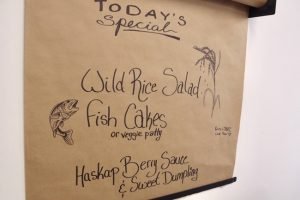
THUNDER BAY — Fish cakes, wild rice salad, and a haskap berry sauce and sweet dumpling dessert were featured at the Roots Community Food Centre and Thunder Bay Indigenous Friendship Centre’s (TBIFC) monthly traditional meal on July 31.
The free meal is usually served for Elders and seniors on the last Friday of the month at the Roots Community Food Centre in Thunder Bay.
“It is important for us to come out to feed our Elders,” says Candace Hardy, volunteer at TBIFC, learner recruitment and support coordinator at Northern Ontario School of Medicine University, and Biinjitiwaabik Zaaging Anishinaabek citizen. “Our Elders have always taught me that food is medicine and that food is a way of bringing people together. It’s a time for creating a welcoming space to welcome our Elders in, sharing a meal together, and be able to talk and share stories and laughter and good medicine.”
Hardy says she has been volunteering with the TBIFC for about two years, including with their gardening program.
“I’ve been gardening for the past two years with the Thunder Bay Indigenous Friendship Centre at the Roots [Community Food Centre] garden,” Hardy says. “It’s so much fun here; it’s very welcoming, everybody’s very friendly — it’s an opportunity to get to meet people and get out and be able to give back to those in need.”
Hardy adds that the food for the traditional meal was all from the land.
“It reminds me of the importance of eating healthy and being able to bring back the importance of our food,” Hardy says, noting that the Elders and seniors are so thankful for being provided with the traditional meal. “They are so grateful and appreciative of the meal that they get to eat. They love coming here; sometimes we have regular people coming in and it’s just a good time for them to be with their friends and people in the community, and they love the food.”
Sheena Campbell, Wiisinadaa: Let’s Eat Nutrition Support Worker at TBIFC, says the traditional meal provides an opportunity for the Elders to get reconnected to traditional foods.
“Living in the city, that’s not always a possibility,” Campbell says. “I love that it reminds them of their youth when they were out fishing and hunting. I love going out there [to the dining room] and listening to those stories.”
Campbell says the traditional meal brings people together.
“People are building relationships, connecting to one another while enjoying good food,” Campbell says. “With the rise of groceries and food insecurity out there as well, this is just something that helps.”
Lenore Doran-Bonk, a member of the Board of Directors at Roots Community Food Centre, enjoyed bringing her grandmother from British Columbia, and uncle from Niagara Falls to the traditional meal.
“I just love showing off all the care that Roots [Community Food Centre] takes of its community members,” Doran-Bonk says. “This is a great way to do it: bring seniors to the lunch and show just all of the camaraderie and how Roots [Community Food Centre] is tackling food insecurity in a dignified way — the food is amazing, as per usual.”
Joan Bonk-MacKenzie, a senior from British Columbia, says this was the second time she has attended the traditional meal.
“I can only say I’m really impressed,” Bonk-MacKenzie says. “I think we share this idea that people should not have to be insecure about their food, and this is a wonderful way to show it.”
Erin Beagle, Executive Director at Roots Community Food Centre, says the haskap berries were donated by a grower on Candy Mountain Road.
“When we can plan these meals together [with TBIFC], especially using wild and traditional and cultural food, people do come from far within our region,” Beagle says. “They’ll drive 45 [minutes] to an hour to come so they can have moose or deer or fish prepared traditionally, and sometimes the [Thunder Bay Indigenous] Friendship Centre also brings some of their Knowledge Keepers to share stories about the food or about the time of the food or why this food is important in a cultural way, which we always appreciate.”