
Lac du Flambeau interpreter brings traditional knowledge to Fort William Historical Park
By Rick Garrick
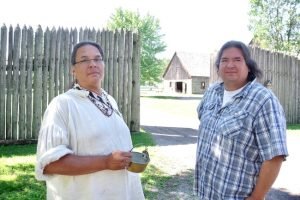
THUNDER BAY — Lac du Flambeau’s David Turner, an interpreter at Fort William Historical Park, recalls how he learned some of his traditional knowledge when he was a young man in the United States.
“When I was a young man, I worked with a pow wow vendor that had a brick-and-mortar store, and so I learned about beads and beadwork,” Turner says. “And then as I got more familiar, I learned how to prepare beadwork, and I was producing beadwork for the store, modifying sterling jewellery and such, doing regalia for custom orders, and that kind of set that ball rolling on the material culture.”
Turner says that experience opened the door for him with other traditional skills such as working with birch bark and porcupine quills, as well as learning how to do split basketry and finger weaving.
“For the last, I would say, 20-22 years, I’ve been doing little events throughout the country, usually in Minnesota, Wisconsin, [and] I was at Festival du Voyageur in Winnipeg off and on for the last 12 years,” Turner says. “It’s interpreting the history of the fur trade from the Indigenous perspective.”
Turner says he is part of the North American Voyageur Council, which is a nonprofit educational organization for individuals interested in various aspects of the fur trade era (1740-1830). The North American Voyageur Council is scheduled to hold their 2026 Fall Gathering for members only at Fort William Historical Park from November 5-8.
“About 20 years ago, we were up here for the Fall Gathering, and Dave Brown had agreed to do a workshop on snowshoe weaving,” Turner says. “And I had a pair of snowshoes that needed to be weaved, so it seemed like a good fit.”
Turner says he had a pair of Ojibwe pattern snowshoes.
“It’s just learning how to do that hexagonal pattern; you have to make sure you’re going over and under in the right pattern to keep it going,” Turner says. “Historically, you would see where they would have the red yarn tufts along the outside. Whether that actually had a function or it was just to please the Spirits, I had to incorporate that onto mine.”
Turner says he has always enjoyed making things and learning how to do something new.
“I must have re-laced my snowshoes two or three times,” Turner says. “Eventually, I will make another set, and they will be better; it will be a tighter weave. As I’ve gotten older, because now I’m in my 50s, I’ve learned that patience to do the little things that may take 100 hours to get done.”
Elliott Cromarty, Indigenous Heritage Program Coordinator at Fort William Historical Park, says the interpreters are relied on to provide mentorship to the newer staff at Fort William Historical Park.
“With Dave in his role here, what I’m hoping to do is utilize his experience and knowledge to identify some of our gaps at the [Anishinaabe] Encampment, things that we can do to improve it, exhibit-wise, interpretively and so forth,” Cromarty says. “This is kind of a starting point for his role here at the park and hopefully we can continue on this relationship.”
Cromarty says Turner’s role includes interpreting Anishinaabe history and culture in relation to The North West Company and the fur trade at the Anishinaabe Encampment.
“Part of his role is going to be manufacturing of goods, construction of wigwams, and helping with other exhibit development, and then as well providing interpretive knowledge on site,” Cromarty says.
Cromarty says his own role is about working with community groups, ensuring they are supportive of the Indigenous community, hosting Anishinaabe Keeshigun on August 22-23, coordinating the interpretive program at the Anishinaabe Encampment, and providing training and tools for the student staff to utilize.
Anishinaabe Keeshigun is a free event that celebrates First Nations culture at Fort William Historical Park. It features entertainment, hands-on activities, demonstrations that highlight Anishinaabe culture, traditions, language and technology, a pow wow with regional dancers and drum groups, and a community feast on Saturday.
Information about Anishinaabe Keeshigun is posted on the Fort William Historical Park website.