
‘Anishinaabe E’Dbendaagzijig Laws are a living expression of Anishinaabe identity, responsibility, and belonging,’ says Citizenship Commissioner
By Marci Becking
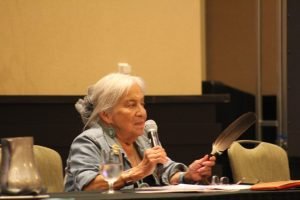
CHIPPEWAS OF RAMA FIRST NATION – Anishinabek Nation E-niigaanwidood E’Dbendaagzijig (Citizenship Commissioner) Dr. Jeannette Corbiere Lavell addressed over 100 participants on day one of the E’Dbendaagzijig (Those who belong) Conference in Chippewas of Rama First Nation from August 19-20.
Commissioner Corbiere Lavell says that within the Anishinabek Nation, First Nations’ inherent jurisdiction is recognized; First Nations decide who belongs, eliminating the imposed second-generation cut-off via the Indian Act, and follow a One-Parent Rule, adopted by the Anishinabek Nation.
“Anishinaabe principles are the roots that will support the practical work we will do to further develop our Laws on Those Who Belong,” said Dr. Corbiere Lavell. “This is a renewal process. This is about renewal of Anishinabek authority and Peoplehood, Nationhood, renewal of our families and communities and our Nation because the Indian Act was meant to oppress, dispossess, and force assimilation.”
In 2009, the Anishinabek Nation Grand Council adopted the E’Dbendaagzijig Naaknigewin, a framework for Anishinabek First Nation citizenship laws. This framework law centres on the One-Parent Rule and is based on the inherent right of self-determination. The Citizenship Law, with the support of the E-Niiganwidood E’Dbendaagzijig Dr. Corbiere Lavell, was the response to the Government of Canada’s Indian Status termination policies. The proposed law is a guiding document, akin to integrating Anishinaabe Law and principles as expressed in Ngo Dwe Waangizid Anishinaabe (One Anishinaabe Family). More recently, a Declaration was established in 2025 to advance the law.
“As Commissioner for the Anishinabek Nation, I advocate for E’Dbendaagzijig,” stated Commissioner Corbiere Lavell. “In February 2025, we adopted the Anishinabek Nation Declaration on E’Dbendaagzijig, which expresses the foundation of our jurisdiction and First Nations citizenship laws.”
“The Anishinabek Nation Declaration on E’Dbendaagzijig further supports Anishinabek First Nations to assert our nationhood and implement our Anishinaabe citizenship laws,” said Dr. Corbiere Lavell. “Anishinaabe E’Dbendaagzijig Laws are a living expression of Anishinaabe identity, responsibility, and belonging. This framework outlines what should be included in First Nation Law. Whether a First Nation will transition to Anishinaabe practices and laws of Belonging, or whether the First Nation intends to control membership through a federal law or Indian Act model.”
The Declaration on E’Dbendaagzijig states that only Anishinabek First Nations have the right to decide who belongs within their communities, and that the Government of Canada has an obligation to recognize and support inherent, Aboriginal, and treaty rights by recognizing First Nation rights. This will require land and financial resources to support recognizing their citizens.
“In our original governance system, the Doodemaag (Clan) system, we have the gift of reciprocity. We can shift from colonial concepts of rights and benefits toward the Anishinaabe concept of giving and using our gifts for the collective. Belonging is maintained through what we give to our clan and community. Anishinaabe Principles are the routes that will support the practical work we will do to further develop our laws on those who belong. This is about renewal of the Anishinabek Nation.
“It is our inherent right to self-determination and our sovereign right to adhere to our own governance laws. As shared by our Elders from our traditional teachings, it requires our attention now,” stated Commissioner Corbiere Lavell. “I want to stress that the foundations of the work we have done is grounded in the Anishinabek Nation Chi-Naaknigewin and our Declaration on E’Dbendaagzijig.”
The second-generation cut-off provides that after two generations of out-parenting (parenting with a person who is not registered as an Indian), the descendants cannot be registered as Indians. First Nations citizens registered under Section 6(1) (full status) can pass on their Indian status, but those registered under Section 6(2) (half-status) cannot transmit status in their own right. Due to decades of historical sex and racial discrimination, this cut-off impacts First Nation women and their descendants sooner and more harshly than the descendants of First Nation men.
For more information on E’Dbendaagzijig or Bill S-2, An Act to amend the Indian Act (new registration entitlements), please visit the Anishinabek Nation website.