

Gift of Spirit Name drives Language Keeper in Nipissing First Nation’s Ojibwe revitalization
By Kelly Anne Smith
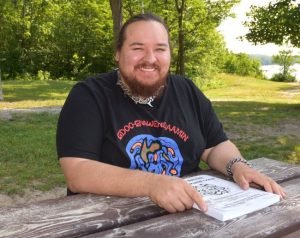
NIPISSING FIRST NATION — Falcon McLeod was given the responsibility of being a Nipissing First Nation Language Keeper at a young age. He has worked hard honouring his Spirit Name and is now the author of the Nipissing Dialect Nishnaabemwin Reference Grammar Book (First Edition).
An important tool for language revitalization in his community of Nipissing First Nation, McLeod’s Nipissing Dialect Nishnaabemwin Reference Grammar Book (First Edition) helps learners express themselves. Falcon explains his Anishinaabe name means Keeper of the Language.
“My Dad was like, ‘Holy jeez! What a weight to put on a five-year-old’s shoulders.’ I didn’t quite understand what was going on with the ceremony. I asked my Dad, What is my Anishinaabe name? ‘Nishnaabemwin-Bemwidood.’ What does that mean? ‘Keeper of the Language,’ he said. ‘It’s your duty to learn the language.’ At five years old, I said, Okay, got it. My Dad was pretty impressed with my reaction.”
The author credits his mother, Laurie McLeod-Shabogesic, for his early learning of Anishinaabemowin.
“My Mom was the closest I had to a speaker. She lost the language at a young age. She knew some. She was a super Mom. She’d work a full-time job, handled three wild rez kids and all of our extracurricular activities, and maintained the house. And then on top of that, I would bug her to teach me Ojibwe. I don’t know how she managed this, but she would make language resources. She’s made these magnets that she put on the fridge, and we’d learn nouns like animals and numbers. And then, she would teach us language to use around the dinner table. And she’d have language lessons with vocabulary to teach us. And she would also coordinate games. We would do bingo in Ojibwe. She even made her own bingo with colours and shapes to teach us.”
From a young age, Falcon was making lists about words and concepts he wanted to learn. He picks up his grammar book and says, “This is like a culmination of a lot of the lists.”
Falcon has taught the language to children in Nipissing First Nation in a summer program.
He has been teaching within the Near North District School Board for about eight years and at Nipissing University in the Indigenous Studies Department for just over four years.
The author says the idea for his book came when he was in immersion camps in Thunder Bay.
“We don’t even start yet, and we meet one of the facilitators, and immediately he’s speaking circles around us. There were a bunch of people around my age speaking fluently in the language.”
McLeod focused on what they were doing differently to encourage language knowledge.
“One of the things that they did was they had some access to linguists. They helped study the language and break it down and make it more digestible for learners, in more effective ways.”
Falcon was able to contact some of the linguists, like Awanigaabaw/Dr. Brendan Kishketon, Dr. John Nichols, and Patricia Ningewance, who is prominent in Ojibwe language revitalization, and her grandson Aandeg Ningewance Muldrew.
“I met Rand Valentine, who has this big blue book called Nishnaabemwin Grammar Reference. Before going to the camp, I couldn’t read the book. But after going to the camp and meeting some of the linguists and being in contact with them and having them explain the concepts, I’m able to read that book and piece things together on my own.”
He reflects on that time in 2014 that sparked his book.
“I needed to make my own Nishnaabemwin reference grammar book but for my home dialect of Nipissing. I knew it had to be done. We don’t have a dictionary in Nipissing and we didn’t have a grammar reference book. I figured that would be on me to work on. I have an online dictionary that needs a lot of work.”
He holds up his book and says, “This version is not completed. I even address that in the first chapter. For now, this is more than enough for what people would need to teach a variety of ages and classes. And you can use it for self-study. I use it for linguistic work. This book is for those who don’t have a linguistics background.”
In explaining the different names for the language, Falcon says when we talk about Ojibwe in English, we tend to favour Ojibwe.
“Ojibwe is the umbrella term for all Ojibwe language and its dialects. Nishnaabemwin or Anishinabemowin is our Ojibwe word for our language. And then there are dialects that pronounce all their vowel sounds. They will say Anishinaabemowin. Then there are some dialects that will destress those short vowel sounds, and they’ll say Nishnaabemwin.”
As a Language Keeper, Falcon worked at learning the language and its concepts and then framed it in a way that people without linguistics could understand it. He found that making worksheets for high school students was a way for them to step out of their comfort zone and speak freely, he says.
“The more I made those worksheets, the more I realized the students needed material to reference. That’s where the charts from this book started happening.”
Falcon set 2026 as his deadline to self-publish. A former student of his, Nipissing First Nation’s Heather Couchie, was the editor of the Nipissing Dialect Nishnaabemwin Reference Grammar Book (First Edition).
“She went on to learn at Georgian College. She really wanted to speak more Nipissing dialect, so I would share the early versions of the charts and work with her. She really understood what I was going for.”
Falcon says the language is connected to the land and culture.
“Being someone from Nipissing, I really wanted to incorporate our cultural perspectives to this material to make it culturally relevant and approachable for people.”
The cover art and text were all hand-drawn by Falcon. He points to the text on the cover and says, “The text here, gedoo nawindamin nbiising enwang, says we are taking care of the Nipissing dialect.”
Falcon explains the artwork.
“I’ve grown up with my father telling me the story of the serpents of Lake Nipissing from the Manitou Islands. The Manitou Islands are here, and the serpents are coming from there. I thought that was a great story of the land with a strong connection to the community. The colours are my spirit colours: red, orange, blue, and green. That was a way to incorporate myself into that.”
McLeod tries to only speak Ojibwe with his two sons. His mother is supportive of that and speaks to her grandsons in the language. His father, Perry McLeod-Shabogesic, will listen and try to speak as well.
“My oldest is five, Shkodeninj (Hand of Fire) and Niibaaboonwe (Night Time Winter Voice) is two years old. My partner Marie (Chalykoff) wants to incorporate the culture as much as possible. We really wanted to name the boys Ojibwe names.”
Falcon McLeod is proud of his book, Nipissing Dialect Nishnaabemwin Reference Grammar Book (First Edition), knowing it will help learners.
“When you use this, there are countless things you’re able to express in conjunction with the Nipissing Dictionary; they are two resources that work together. It will be a huge step to language revitalization for our community. There’s hope for Ojibwe if we have our grammar and our vocabulary together; parents could facilitate that language production in the home.”
Nipissing Dialect Nishnaabemwin Reference Grammar Book (First Edition) is now available through lulu.com and Supplies for the Soul.
Falcon McLeod’s language teachings are also available on his YouTube channel.