

BEAHR program brings environmental monitoring skills to Fort William First Nation
By Rick Garrick
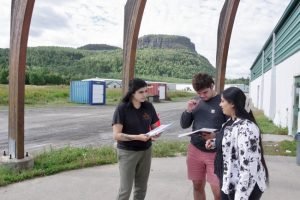
FORT WILLIAM FIRST NATION — A cumulative land-based activity was featured at ECO Canada’s BEAHR (Building Environmental Aboriginal Human Resources) Environmental Training program, held August 31-September 18 in Fort William First Nation at the Cultural Room.
“Today we had to draw a map of the environment, and we had to take notes of how the climate was, how the soil is, how it affected wildlife, how the habitats are, basically how the environment is,” says Bruce Bouchard, a training participant from Fort William First Nation. “[The course] was pretty good, I learned a lot. What I found interesting was how much [Indigenous people] know about the environment — how they know when migrating season is, how they know where the good fishing spots are, where they hunt.”
Josie Fenton, a training participant from Fort William First Nation, says the Environmental Training program was “very good and informative.”
“We were looking at the environment in the area, the different types of trees, wildlife, listening to see if there’s any birds nearby,” Fenton says about the cumulative activity. “And then the different types of flowers, plants, soil, concrete, the land basically, and the infrastructure.”
Leo Tookenay, a training participant from Fort William First Nation, says some of the key points he picked up at the Environmental Training program were about the environment and big business coming into the area.
“You have to ask more questions,” Tookenay says. “Our Elders and the community should have more information and be able to ask these questions, and the companies coming in, whether it’s for trees or for putting a business on the reserve, what are the assets and what are the disadvantages of them coming in — that’s what I’m learning from this program. I just enjoyed this program and I’m glad I had the opportunity to participate in it.”
Preni Jani, BEAHR Environmental Trainer with ECO Canada, says the purpose of the cumulative activity was to bring together all of the knowledge the participants had gained into one project.
“They’re creating a monitoring project specific to this setting and basically this community,” Jani says. “We’ve got members working on vegetation, members working on soils, we’ve got members working on wildlife in the area, and they’re working on a monitoring program, what they would do, what kinds of wildlife, what kinds of soil are present, what is impacting them, what might have changed from the historical aspect of it to what’s changed in the current state, like how it is right now.”
Jani says she has delivered the Environmental Training program in different communities across the country.
“We do this across Canada because every community is different, every community’s needs are different,” Jani says, noting there are communities north of Thunder Bay that are impacted by mining projects. “So, after they do this course, then we will focus them on contaminated sites, or we will focus them on land use administration so that way they can establish a foundation for themselves based on the needs of the community.”
ECO Canada states that the BEAHR Indigenous training programs offer locally customized learning that provide accessible and meaningful career development to First Nation, Métis, and Inuit members to overcome barriers to employment and develop competencies needed to actively contribute to Canada’s growing environmental sector.
“If we’re able to make a better environment around us just by knowing how to take action where and when needed, that’s our key role,” Jani says. “We’re giving the people the tools to stand up and say, ‘Hey, what you’re doing is wrong, stop, we should be doing this better and I know how to do it.’”
Information about the BEAHR programs is posted online.