

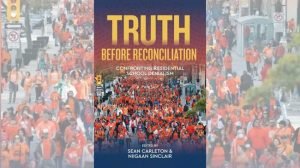
Truthful, thoughtful, and thorough is the perfect way to describe the new book, Truth Before Reconciliation
Reviewed by Ella Miller
Truth Before Reconciliation: Confronting Residential School Denialism by Sean Carleton and Niigaanwewidam James Sinclair is an absolutely essential resource for anyone who is looking to combat Residential School denialism or learn more about the systems by which misinformation is spread.
The book is a compilation of academic essays, topical reflections written by experts, and interviews conducted by the editors of the book. It features the voices, among others, of history professor Erin Millions, Assistant Deputy Attorney General for Indigenous Justice Kimberly Murray, Member of Parliament Leah Gazan, and Orange Shirt Day co-founder, Phyllis Webstad.
To better contextualize this review, I think it’s worth disclosing a few things about myself, as the reviewer that influenced how I interacted with this book. I am of Irish settler descent, meaning that my own family does not include any Residential School Survivors. I am certain that Truth Before Reconciliation would be an affirming, but potentially very difficult read for Survivors and their families due to the explicit discussion of the abuse suffered by children in these schools.
Returning to that word: “affirming”, Truth Before Reconciliation employs a Two-Eyed Seeing approach to addressing the plague of Residential School denialism. The book includes both the voices of Indigenous Elders and community members who discuss the personal, cultural, and spiritual harms of denying the lived reality of Survivors and their families; it also employs Western academics and Indigenous peoples working within Western institutions to discuss the legal and statistical ramifications in Canadian society.
Every chapter of the book builds off the previous one, starting out with basic definitions of what denialism is, how truth can be defined, and the tactics used by denialists to spread their toxic messaging.
Stand-out chapters in my read-through of the book include: “What We Choose to Forget: Residential School Denialism and the National Centre for Truth and Reconciliation Archives,” which reminds us that everything, especially as it pertains to the legacy of Residential Schools, is political; “Understanding the Role of Archeology in Residential School Searches,” an immensely helpful breakdown of how ground penetrating radar works; and, “Protecting Survivors,” in which cross-national solidarity for Survivors is explored.
The vast array of tone, genre, and personality represented in the book is a huge credit to the editors, Carleton and Sinclair, and the research they put into finding the most compelling personalities combating Residential School denial. Special praise must be allotted to Sinclair who is honouring his father, Murray Sinclair baa, who chaired the Truth and Reconciliation Commission, with this work.
I would be remiss not to mention, though, the few issues I had with Truth Before Reconciliation. As is common with independently published works, there are spelling and grammar errors that slipped through and made it to print (sometimes multiple per chapter).
The quality of the photographs and data sets printed in Truth Before Reconciliation is not great either, with some being blurry and hard to read in certain cases. These issues do not in any way dissuade me from wholeheartedly recommending the book, though.
Another area of potential improvement – perhaps in a second volume – would be to explore how intersectional identities can play into Residential School denialism and affect those combatting it. This is touched upon by Gazan, who is both Indigenous and Jewish, and through these identities is a multigenerational Survivor of two genocides.
Intersectionality is also referenced by Kimberly Murray who discusses how denialists are quick to attack her gender and weight when confronting her. The specific ways in which gender, sexuality, class, and religion may be weaponized by Residential School denialists is fertile ground that I would love to see explored more by Carleton and Sinclair, should they continue work in this space.
Unfortunately, Truth Before Reconciliation has already begun to be attacked by Residential School denialists and, dare I say, flat-out racist people who have left negative reviews of the book on sites like Amazon, containing the exact rhetoric the book decries.
This only proves how necessary and how dangerous literature like Truth Before Reconciliation can be in the dismantling of violent, harmful mindsets.
The nuanced, well-researched, and comprehensive information that Truth Before Reconciliation lays out is an achievement in Canada’s collective journey towards reconciliation. It is a necessary asset and purchase for the bookshelves of anyone who is interested in a truthful, thoughtful, and thorough dissection of Residential School denialism.
To learn more about this book or purchase your own copy, visit the University of Manitoba Press’ website.
Sean Carleton and Niigaanwewidam James Sinclair, Truth Before Reconciliation: Confronting Residential School Denialism. Winnipeg: University of Manitoba Press, 2026
ISBN 9781772841626