

National gathering brings Indigenous midwives together in Thunder Bay
By Rick Garrick
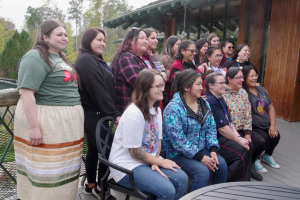
THUNDER BAY — Red Rock Indian Band’s Lana Ray highlighted Indigenous women’s leadership roles and health transformation during her presentation at the National Council of Indigenous Midwives 2026 Gathering in Thunder Bay. Held September 23-24 at Fort William Historical Park, the gathering brought together Indigenous midwives, midwifery students, and supporters from across the country.
“I know all of the amazing work that midwives do and I’m just kind of in awe about the life-giving work that you do,” says Ray, Associate Professor at Athabasca University, noting how she and the gathering organizers had decided to do the presentation on health transformation. “One of the things that … I wholeheartedly agreed with was the role of midwives in regard to health transformation, and then I started to think about pre-invasion and our governance systems, and how women were really held up in leadership roles. We never saw that separation between people who also had responsibilities for life giving, for nurturing, and for governance, so to me it makes perfect sense that we’re having a conversation about health transformation with all of you here today.”
Ray adds that the core of the work that midwives do is about “centring life, nurturing, and relationality.”
“In some of the work that I do with [Waasegiizhig Nanaandawe’iyewigamig] around traditional healing, they always remind us when I kind of get into researcher language [that] this isn’t a program or this isn’t an intervention, this is a way of life, this is a ceremony, so I think that understanding is essential to thinking about health transformation,” Ray says. “It’s really just about taking that way of relationality that you already have in community with land and Creator, and also thinking about it at different levels and different planes in regards to health transformation.”
Laura Mayer, Executive Director at the National Council of Indigenous Midwives and a Mississauga #8 First Nation citizen, says they have a national gathering every year.
“Normally we have separate events, a land-based learning that’s geared towards student midwives, and we’ve been gathering in Winnipeg in partnership with the University of Winnipeg, but this year we decided to combine the two together so we’ve had land-based learning for a number of days at Fort William Historical Park doing [an] emergency skills workshop, doing some cultural teachings, and then that led into our gathering these last few days,” Mayer says, noting the gathering went really well. “We were able to balance a lot of content between what are the cultural teachings from this area that we want to share with midwives from across the country, what are some of the more recent policy concerns in the regulatory sphere that are challenging midwives and creating barriers to practice, but how do we bring ourselves together and provide best practices to each other to move the profession forward in a good way.”
Tammy Cascagnette, Community Engagement and Outreach Specialist at the Association of Ontario Midwives and a Beausoleil First Nation citizen, says Ontario is the only province with an exemption clause for Indigenous midwives to practice without registration with the provincial midwifery college.
“Our work is focused on Indigenous midwifery and bringing birth back to community,” Cascagnette says. “Back in the mid-2000s, the Association of Ontario Midwives approached midwives working under the exemption to ask them what they needed. What was shared was we need a policy analyst, we need funding to support our work and to build midwifery.”
Cascagnette says they now have 17 Indigenous midwifery programs and one midwifery practice group.
“Part of our work is to advocate for increased funding, changes where we see they’re needed, and to bring birth back [to community],” Cascagnette says. “But we wouldn’t be here if it wasn’t for the Association of Ontario Midwives.”
Nilak Ironhawk-Tommy, a student midwife from Cowichan Tribes in British Columbia, says she has been a student midwife with the National Council of Indigenous Midwives since 2022.
“We began as a group of nine nations across Canada reclaiming the education of midwifery the way that our Ancestors handed it down,” Ironhawk-Tommy says. “We’ve been privileged enough to have some of the original midwives be our teachers. When I began, I didn’t realize that importance of the impact of all of these amazing women that were taking time out of their day to come and spend time with us and teach us.”