

Wesley-Esquimaux calls for continued work on truth and reconciliation
By Rick Garrick
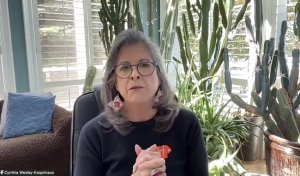
CHIPPEWAS OF GEORGINA ISLAND FIRST NATION — Chippewas of Georgina Island First Nation’s Cynthia Wesley-Esquimaux stressed the amount of work Lakehead University has done on truth and reconciliation during her Lakehead University virtual talk held on September 24 via the Zoom platform. Wesley-Esquimaux’s virtual talk was about Enlivening the spirit and intent of reconciliation: Have we spent enough time addressing the multiple contexts standing between truth and reconciliation in Canada.
“Past, present, and future, [there’s] lots of long-standing work that’s been done or we’re doing or we’re going to do in support of truth and reconciliation as we move forward,” says Wesley-Esquimaux, Chair of Truth and Reconciliation at Lakehead University. “But it’s also the truth part that I think is really important because … we cannot forget about the truth — the whole process that we’re engaged in is about that.”
Wesley-Esquimaux says Lakehead University implemented an Indigenous language program that taught Indigenous language speakers to teach the language to those who wanted to reclaim their fluency in 1973, eight years after being founded in 1965.
“They established the first associate vice provost position in Canada, Dr. Lauri Gilchrist, in 2004,” Wesley-Esquimaux says. “They appointed the first Indigenous faculty member, Dolores Wawia. They appointed in-house Elders before anybody else in Canada actually did that, and Elder Gerry Martin was there throughout my early days at Lakehead [University] when I was still in Thunder Bay. They established this first chair for truth and reconciliation in Canada in 2016, so that was 10 years ago in response to Canada’s commitment to tackle this important work.”
Wesley-Esquimaux says Lakehead University was the first university in the country to establish and launch an Indigenous content requirement.
“And they appointed an Indigenous content specialist to accommodate that, again something that a lot of universities are still not actually doing,” Wesley-Esquimaux says, adding that Lakehead University also has an Indigenous mentorship program. “We’ve done a lot of work, and I think that’s just a small sampling of the commitment Lakehead has demonstrated to truth and to reconciliation as an academic institution. So, we have a lot to be grateful for when it comes to the work that we’ve actually done, are doing, and will do into the future because it has a very strong foundation as we move forward.”
Wesley-Esquimaux says the foundation of peace and friendship on Turtle Island and in Canada in particular remains the “hallmark of our Ancestors.”
“I’d like to believe it’s still living within today’s enlightened and dynamic Indigenous leadership because the foundation of Indigenous society and culture asks us all to live respectfully and strive for harmony in our day-to-day relations,” Wesley-Esquimaux says. “Truth and reconciliation is about honouring relationships, even those that were forged in strife over 400 years ago, and continue to present us with a myriad of unfinished business. We understand and still appreciate how the bringing together of Indigenous world views and European thought can still create a sacred union of goodwill and the promise of harmony and strength for the world in which we now live, especially in Canada. We understand the need for stability and respect; it is after all for Indigenous peoples one of our main teachings.”
Wesley-Esquimaux says there are thriving and beautiful examples of extreme adaptability and continuance across the land.
“We’ve never given up despite the challenges and have worked hard to grow stronger, we met the process of colonization and conflict with a de-colonizing mindset, and it provided a foundation for truth and reconciliation,” Wesley-Esquimaux says. “Those agreements are proof of our honourable intentions, and we have continued to feed the spirit through our commitment. We have not walked away, yes, we struggle to firmly situate ourselves and it is apparent in the struggles of our youth, the addictions, the casual sexuality, critical homelessness, incursions of child welfare, single parent families, grief, and displacement that there is still a significant amount of healing to do across Canada in our communities. We’re not done, and Canada is still really on the hook for ensuring that actually gets fixed.”