

First Nations conference speakers stress importance of future generations while dealmaking
By Sam Laskaris
CHIPPEWAS OF RAMA FIRST NATION – Financial returns obviously play a key role when determining economic development success. But Chippewas of the Thames First Nation Chief Joe Miskokomon believes other factors, including long-term thinking that will generate benefits for future generations has to be considered when negotiating deals.
Chief Miskokomon, who is also Anishinabek Nation Southwest Regional Chief, offered his thoughts on this issue as well as other economic development topics at the recent Forward Summit conference.
The two-day event was staged September 23-24 at Casino Rama Resort, located on Chippewas of Rama First Nation.
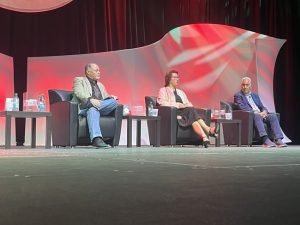
Chief Miskokomon was a panelist on an opening-day session titled Community Capacity & Governance: Investing for Seven Generations.
Chief Miskokomon said some Canadian cities are currently expanding rapidly. The area his First Nation is in, located mere kilometres from the southwestern Ontario city of London, is experiencing tremendous growth.
“Those things have opportunities,” Chief Miskokomon said of expansion plans. “But they also have something more important, in my view. It’s that they’re exploiting our treaty territory without compensation to the rightsholders.
“We’ve done a study within our treaty territory and 98 per cent of our treaty territory is taken up by third-party interests without compensation. And so, one has to question then, how does that, from an Indigenous lens, from a First Nation lens, how does that impact the spirit of the land when we believe land has spirit. Water has spirit. All things that you’ve created have spirit.”
Chief Miskokomon said there are numerous opportunities occurring near Chippewas of the Thames First Nation. These opportunities vary from construction, to pipelines, to transmission lines, to highway corridors, to telecommunications.
“They’re coming so fast from all directions,” he said. “We’re very challenged with capacity, internal capacity, and how to manage that tremendous amount of opportunity.”
Rick Morano, who has served as the Chief Financial Officer for Chippewas of Rama First Nation since 1997, was also a panelist for the session.
Morano was asked how he determines whether his First Nation should move forward on a project and what carries more weight, community impact or financial returns.
“It’s changed over the years,” Morano said. “We’ve developed to the point where we have a business checklist that we go through when anything comes in. We also have business guidelines.”
Morano also said Chippewas of Rama First Nation representatives are keen to be involved with a number of diversified businesses.
“If something comes to us, which has a $100 million project looking for investment, unless there’s partners coming in with this, there’s a chance we probably will turn it down,” he said.
Morano also explained the process for projects that are appealing.
“Once we decide to move forward, then normally we get deeper involved, we’ll sign NDAs with the business or anybody related to it,” he said. “And then we basically start negotiating agreements.”
Morano said business terms of pending deals are often negotiated in consultation with the First Nation’s Chief and Council. And normally a lawyer or two are brought in for guidance.
Morano also touched on how deals that have varying impacts are dealt with.
“We obviously look at the environment, but community impact means we look at a lot harder when it’s a business on reserve,” he said. “And when we go off reserve, financial returns become more of what we’re looking at. We’re obviously going to be looking for jobs. We’re going to be looking for procurement. But the financial returns —we need those funds to come back to the First Nation, help us operate or reinvest into other programs.”
Melanie Assiniwe, a citizen of Wiikwemkoong Unceded Territory who is the Chief Executive Officer of Giyak Mishkawzid Shkagmikwe (GMS), was also a speaker on the panel.
GMS was established three years ago to further the goals of the Atikameksheng Anishnawbek Community Comprehensive Plan and Economic Development Strategic Plan.
“I’m just looking to find a way to make profit that is not going to hurt the community,” Assiniwe said, adding she’s also doing her best to create jobs for First Nation members so they can support themselves.
In his concluding thoughts on the panel, Chief Miskokomon said he believes the future is bright for First Nations and they should be willing to explore opportunities that are brought to them.
“And I really think it’s incumbent upon us to take those big steps,” he said. “Not baby steps. Big steps. We have never had a higher presence in Canada, politically, socially, financially than we do today. And I think that we should not miss the opportunity. I think we should expand and push the boundaries of those opportunities as far as we can. And I don’t think we should be afraid of being told no because we’ve been told no before. And here we are.”