

Fort William First Nation Fall Gathering celebrates culture, community, and generations
By Rick Garrick
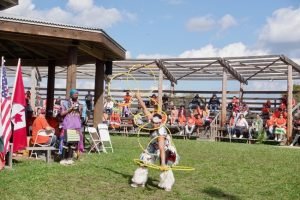
FORT WILLIAM FIRST NATION — A pow wow, a hoop dancer, and a variety of traditional activities, including hide tanning and bone tool making, were featured at Fort William First Nation’s Fall Gathering, held September 30 in Anemki Wajiw.
“It’s a real honour to stand here today and look around — the number of young people that are here, it really warms my heart,” says Fort William First Nation Chief Michele Solomon during the pow wow, noting that many of the traditional ways and practices were not available to everyone during her childhood. “As a young girl growing up, I never ever danced in a pow wow, I didn’t have regalia, so to see our young people — in fact my granddaughter is running around here somewhere and she’s wearing a ribbon skirt that I purchased for her a couple of years ago — it’s a really good feeling as a Chief to see that.”
Brentley Collins, a drummer and grass dancer from Fort William First Nation, says it was important to participate in the pow wow to honour the children who did not return from Indian Residential School.
“It’s to represent the people who lost their lives in the [Indian] Residential Schools and for the children who didn’t come back,” says Collins, who has been on the pow wow trail for about nine years and was the male head dancer at Fort William First Nation’s 2026 Annual Summer Pow Wow. “We’re still here.”
Todd Genno, the pow wow emcee from Biigtigong Nishnaabeg, says it was important to remember what the generations from before did for today’s generation of Indigenous people.
“They kept our language, and they kept our culture alive so that we could live a good life today — with everything that went against them, they held on long enough for us to pick it up so that we could live a good life,” Genno says, noting there were lots of children at the pow wow. “In our culture and in our ceremonies, the children are the centre of everything that we do.”
Eric Michael Hernandez, a hoop dancer and filmmaker from North Carolina who now lives in Los Angeles, says during the pow wow that he began dancing about 25 years ago and has shared the hoop dance around the world with Cirque de Soleil. He also showed his short film, Courage, on the evening before the gathering at Fort William First Nation’s gym.
“The hoop dance originally comes from Taos, New Mexico,” Hernandez says. “It was a healing ceremony; they believe every time the hoop passed through your body you add time to your life. Originally the hoops were made out of willow, and they would only use them once, and then they would set them on fire.”
Hernandez says the contemporary hoop dance was introduced in the 1930s by Tony White Cloud.
“The intertribal hoop dance is a celebration of life,” Hernandez says. “There’s a story being told in the dance, it’s a story of our journey through life as humans, and the different stages and the different plants and animals we see throughout nature and how we can live in harmony with all living things.”
Elder Ma-Nee Chacaby, author of A Two-Spirit Journey: The Autobiography of a Lesbian Ojibwa-Cree Elder, says she enjoyed Hernandez’s hoop dance performance.
“He’s very beautiful what he does, it’s awesome,” Elder Chacaby says. “I give him five stars.”
Wiikwemkoong Unceded Territory Elder Andrew Mandamin says he has been working with the hide tanning camps for about six years.
“I do the bone tools, along with other tasks like making frames,” Elder Mandamin says. “I find this work very rewarding and healing as well too. I didn’t know anything about this to begin with — I just started going to hide camps and I picked up all kinds of ideas of what I would like to do, so this is what I enjoy doing, working on these moose legs to make tools.”
Belmo Belmore, a hide tanner from Sandy Lake First Nation, says they were sharing some teachings about hide tanning during the gathering.
“It has been a healing process for me, and I just want to share that healing, especially on a day like today,” Belmore says. “I have enjoyed having all these students come through and learn as much as they want.”