

Art lovers pack Steve Snake’s solo exhibition
By Kelly Anne Smith
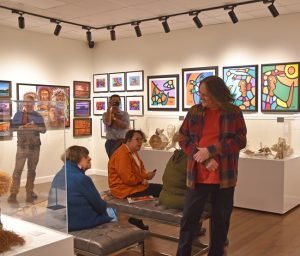
NORTH BAY — Art connoisseurs filled the Bloch Bauers Gallery of Fine Art for Steve Snake’s solo exhibition opening night on October 3 in North Bay, Ontario.
Snake’s extensive new collection features his distinctive impressionist portraits, bold woodlands, and serene landscapes. His expert use of colour dominates.
The exhibition was billed as Snake’s first in 29 years. His paintings are known in private, corporate, and institutional collections. Looking around at his work, Snake commented on the scale of the collection.
“I haven’t done anything like this since ’97. I’ve been very busy. I usually have something on the go,” Snake says.
As a child in Chippewas of Rama First Nation, Snake watched his mother, Carol Shilling, paint at home. Shilling’s first cousin, artist Arthur Shilling, saw talent in Snake and mentored him. Carol Shilling was smiling on opening night of Snake’s exhibition.
“I used to paint when I was younger,” Shilling says. “I took a couple of night classes. I got back into it about 10 years after, but I haven’t painted now for 13 years … Steve used to watch me paint. I think he was 11. One day he says to me, ‘I know what I want to be when I grow up.’ I asked, what? He says, ‘An artist.'”
His proud mother talked about a portrait Snake painted that she has at home.
“I have one at home. It’s from ’95, I think. He was very young then,” she says.
Snake is the master of Indigenous Impressionism, using bold strokes of colour in his portraits.
“I take the beauty of my people another step further. That’s the fun of it. I do a lot of 1800s photos. They are all dressed up like that. I’m putting them in colour. I pretty well did all of Edward S. Curtis’s photographs. They got the look. All the ones I do got something,” Snake says.
Snake’s partner, Verna Friday, spoke of their life together on Bear Island. They have lived on Temagami First Nation since the early 1990s. Snake connects deeply with the land in his work.
When asked about his recent landscapes, Snake brightened up and said he was having fun with them.
“I do a lot on location. If I see something, I’ll stop. There it is. The distractions aren’t around. It’s good that way. I can step out any day and go do this, and it’s not far away. It’s right outside the door. There are hundreds of scenes here. There are 1,300 islands. It’s a great-sized lake. It’s really good, and every day is different. And if I get bored, I might paint myself.”
Friday was not born on Temagami First Nation.
“I didn’t grow up on reserve; I was born out on tribal lands—I like it better on my tribal lands. Our lands are still there, and we still use them for hunting, fishing, and gathering wild rice,” Friday says.
Friday explained that Snake portrays renowned Indigenous artists who influenced him.
“He had a project of doing portraits of all the Native artists,” Friday says.
Bloch Bauers Gallery of Fine Art Curator Joey Nadeau adds that Snake painted two versions of Morrisseau and Thunderbird for the exhibition, depicting them at different ages.
“He did one of young Morrisseau. He just did this,” Nadeau says.
When asked about the influence of Morrisseau and Shilling, Snake says he liked what he saw.
“That’s why I painted them in this show because I just wanted to show that’s where a lot of the inspiration came from,” Snake says.
Snake was thoughtful, giving insight to up-and-coming, young artists.
“They are going to have to be dedicated. I think that’s the main thing,” Snake says.
Snake was amazed at how well received his exhibition was in North Bay.
“I couldn’t believe it. It stunned me. I didn’t expect that. Because I’m back in the bush, I don’t really talk to a lot of people. I hardly leave,” Snake says.
A selection of Snake’s paintings can be viewed online.