
Dr. Alan Ojiig Corbiere explores Anishinaabemowin, Clan identity, and Treaty of Niagara
By Rick Garrick
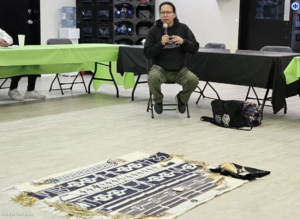
ZHIIBAAHAASING FIRST NATION — M’Chigeeng First Nation’s Dr. Alan Ojiig Corbiere highlighted his path to learning Anishinaabemowin, his Clan, and about the 1764 Treaty of Niagara during his Zhiibaahaasing Cultural Speaker Series presentation on October 22 at the Zhiibaahaasing First Nation Complex. The presentation was also shared online through the Google Meet platform.
“When I was growing up, I heard Anishinaabemowin every day because my mom and dad would talk to each other, and then they would turn to us, my siblings and I, and speak in English,” says Dr. Corbiere, Canada Research Chair in Indigenous History of North America and Assistant Professor at York University. “So, I ended up deciding to try and learn — I’m not fluent, but I learned quite a bit. It was by recording Elders, and when I listened to the Elders, then I would write out what they said and I would translate it and then I would go and visit them again and say, ‘Is this what you said, do you agree with this translation.’ So that’s how I learned what I know now — the amount of Anishinaabemowin that I speak is based on that.”
Dr. Corbiere says he also became interested in learning what his Clan was, noting that he first asked his father, who told him it was Bne, ruffed grouse.
“And then, of course I asked some people, like this traditional person,” Dr. Corbiere says. “I said, ‘My dad said our Clan is the Bne.’ Then that person said to me, ‘That is a sub Clan.’”
Dr. Corbiere says he discovered information about the 1764 Treaty of Niagara when he found a bunch of letters written in Anishinaabemowin from between 1840-1900 in a document dated June 27, 1862, while doing research in the United Chiefs and Councils of Mnidoo Mnising archives.
“The first words were … ‘I still remember or know how you talked to my Ancestors when you wanted them to fight or go to war,’” Dr. Corbiere says, translating from Anishinaabemowin. “‘You had said that your children would own that land over there and you said this at Niagara,’ but of course it doesn’t say Niagara, it says wayaanag — when you go to the bottom of a waterfall, it’s scooped right out, it’s a basin, and that’s what that wayaanag means, it’s a basin, so that’s what the Anishinabek called that Niagara, wayaanag.”
Dr. Corbiere says the next part of that letter said, ‘The British had told our Ancestors, don’t look to the south, or the west, or the north for the support for the life of their children, only where the sun rises, that’s where you will look for the support of your children.”
Dr. Corbiere says the letter continues by stating that as the sun rises higher, it will be shining brightly everywhere.
“Then all over this land as that sun gets even higher, all over this land it says flowers will appear, they will open up,” Dr. Corbiere says. “And then this is the thing that they say … ‘That’s the image of the life of your children, if you accept this wampum belt.’ So, those are the promises they made to us, that everything was going to be nice sunny days and we were going to have a nice tiptoe through the tulips, and our life was going to be good if we accepted.”
Dr. Corbiere says as he read more, he realized the letter was about the 1764 Treaty of Niagara and how it was passed down.
“That meeting was a big meeting, there were thousands of Native people there,” Dr. Corbiere says, noting that the meeting included Anishinaabe, Menominee, Ho-Chunk, Sauk, Fox, Sioux, Cree, Odawa, Potawatomi, Algonquin, Nipissing, Mississauga, Six Nations, Mi’kmaq, and Abenaki peoples. “And they ended up having this big feast and it was a month-long gathering. Around August 1, 1764, Sir William Johnson writes, ‘I crossed the Niagara River, and I went to the western nations’ camp on the opposite side of the river, and I delivered the Great Covenant Chain Wampum Belt.’ He said, ‘I take this belt and one end of it remains at my house and the other end I’m going to tie at Sault Ste. Marie.’”
Dr. Corbiere says the Anishinaabe Chief said the Great Covenant Chain Wampum Belt and the 24 Nations Wampum Belt should be kept at Michilimackinac with the Odawa.
“So, this is how the Odawa ended up becoming the keepers of these belts,” Dr. Corbiere says.