

Indigenous Veterans Day Ceremony highlights treaty rights, service, and sacrifice
By Rick Garrick
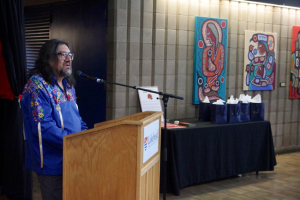
THUNDER BAY — Biinjitiwaabik Zaaging Anishinaabek’s David Michael Thompson shared the First Nations perspective on treaty rights during his presentation at Lakehead University’s National Indigenous Veterans Day Ceremony on November 9 at the Thunder Bay campus. The ceremony brought together Indigenous leaders, Elders, veterans, and community representatives to honour and remember the contributions and sacrifices of First Nations, Inuit, and Métis peoples.
“We are the Ojibwe people of this land, we are the rights holders, nobody else,” says Thompson, Research Developer and Project Manager of the Native Veterans Association of Northwestern Ontario. “Anybody else that comes into our territory, you’re a visitor, behave like a visitor, show us respect, don’t disrespect us, and that was the message when we signed this treaty (Robinson Superior).”
Thompson says First Nations people didn’t give up anything in terms of their inherent rights such as being self-governing people, sovereign people.
“Those things aren’t negotiable, they’re still with us, those weren’t given up at any point,” Thompson says. “And we still held back our hunting rights, our fishing rights, our gathering rights, everything we needed to do to make a living off the land. Some people have the misconception, ‘Oh yeah, you guy’s got fishing rights, we gave those to you.’ No, you don’t understand what the treaty was about — many of those things were held back by us because we needed those, they were not negotiable, we needed that to survive.”
Thompson says when they put their signatures on the treaty, they put down all of their weapons of war.
“We agreed that we’d share with the newcomers, the settlers, and go forward in our futures, travelling in our own canoe and their vessel together and not cross over and create conflict,” Thompson says.
Thompson says First Nations people have gone overseas to help the Crown with various wars since the 1800s.
“Each time we were called out, we volunteered,” Thompson says. “Because of our treaties, we felt connected, we had to be part of it. And our youth, against the wishes of their parents and grandparents, they volunteered and enlisted and served in high numbers. We are one of the small groups of populations on this land that have highest per capita of service as volunteers, and we continue to do it.”
Mattagami Elder Gerry Martin, a Canadian Forces veteran, says he joined the Canadian Forces in 1966.
“What I like best about having been in the military is it led me to become a nurse,” Martin says. “I didn’t like killing and hurting people, I liked helping people.”
Martin says living in peace and harmony with all of nature is the rule he lives by.
“Not just some things, all things, and when we can live that way and acknowledge one another, we’re doing what the Creator wants us to do,” Martin says. “To hold the hand of a brand-new baby that just came out and clean them off and hand them over to the mom, that’s a beautiful thing. To hold the hand of a wrinkled soft old veteran taking his trip to the Spirit World, that’s beautiful.”
Biigtigong Nishnaabeg Elder Beatrice Twance-Hynes shared a hand drum song she created based on the poem by John McCrae, In Flanders Fields, during the ceremony.
“Many years ago, probably around 2012, I wanted to honour our Indigenous veterans,” Elder Twance-Hynes says. “I know In Flanders Fields, so I added a chant to it, but before that I offered my tobacco, then I had my bath because I believe the water spirits help me when I want to be creative. I was reflecting on the song and then that vision came of what I should add, so I added that chant. Then I started singing it with my drum and I put those honour beats in there to honour them as well. Those [honour beats were] to honour those who sacrificed themselves in fighting for our freedom.”
The ceremony also featured presentations by Denise Baxter, Wendy Houston, MPP Lise Vaugeois, Annika Gregg, and Scott Bradley.
The Indigenous Veterans Exhibit, which was on display at the Agora, where the ceremony was held, was scheduled to be open for public viewing from November 9-13.