

Nipissing University awards distinguished educator
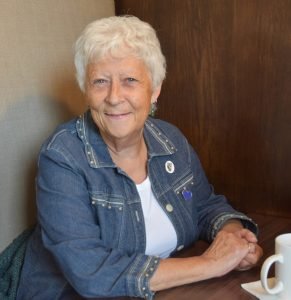
By Kelly Anne Smith
NIPISSING FIRST NATION — Fran Couchie has always been keen on improving outcomes for students across the province. Her work has made a difference for all children, especially for Indigenous students.
Nipissing University has recognized her contributions to education by presenting her with the Distinguished Alumni Achievement Award. Couchie received the award in October during the annual Alumni Awards ceremony hosted by the Nipissing University Alumni Advisory Board.
Couchie speaks of two strong, influential Nipissing First Nation women she learned from.
“You never do that stuff alone. It’s always with other people, or as they say, ‘on the shoulders of others in the work that’s gone before’,” she says. “[Former] Chief Marianna Couchie-[baa] and [former] Deputy Chief Muriel Sawyer[-baa] were very dedicated to education. Both were really good mentors for me. So, listening to them and trying to understand their vision and their goals and then doing the best I could to move things forward.”
One project that Couchie has been involved with since 1993 is The Looksee Checklist, a tool designed to help parents and educators monitor children’s development from one month to six years of age in response to a need for greater support for parents and young children.
“We saw a need in this area, in this community. That was a time when the government was really supporting the importance of the early years and early brain development and trying to maximize supporting parents,” she says. “Parenting is a difficult job; we’re not born with a manual on how to raise kids. We worked closely with Dr. (Joseph) Madden; he was [the] Chief Pediatrician at the time. He said to us, ‘It has to be simple. No scoring. Keep it simple, quick, and easy.’ And our goal, it still is, to get it into the hands of parents.”
The checklist has since been used in communities across the country, including First Nations, something Couchie says has been an important part of her work. Through this work, Couchie and her colleagues recognized that children were not always receiving the support needed early enough.
“We were all seeing the same things where little ones were sometimes coming to the attention of the school,” says Couchie. “Trying to get earlier services were hard to get with waiting lists. We started in the early ’90s and we are still dealing with waiting lists for those services.”
Couchie explains the checklist was created to allow for the range of development.
“We often use the example of our 18-month checklist with walking alone. On the standard, for any kind of development test, it’s 12 months,” she says. “If the child is not walking alone at 18 months, you really need to talk to a doctor or childcare professional. The little one obviously needs some help. And parents, too. Our goal was never to override or over-identify or scare parents. It was really just a guide. Here are some things that the majority of children at this age can do. If your child can’t, then ask some questions.”
For Couchie, the importance of the work extends beyond the checklist itself.
“The work has been really rewarding and interesting,” she says. “Governments come and go. There’s not so much emphasis on it now, yet, those beginning years—that’s the foundation. Support for children and young families is really important, the preventative piece.”
In her work with Nipissing University, Couchie calls herself fortunate to be working for post-secondary students.
“Initially, when I worked as Director of Education for the First Nation, they had the Indigenous Education Council. Typically, in the First Nation communities, education directors or managers are invited to sit on that advisory committee. That was my first involvement,” she says. “At the time, Laurie Robinson was the Director of the Office of Indigenous Initiatives. That program was doing outreach into communities. We were offered education students from the university who would be interested in doing some work within the community of some capacity…We had faculty of education students coming in and working with the children in the community after school with homework help, which was a benefit for our children, but was also a benefit for those students because a majority of them had never been into a First Nation community. It worked really, really well.”
In 2007, Couchie was invited to participate with the Nipissing University Indigenous Council on Education (NUICE).
“I thought that was really important because it brings the community voice into the university. It gave me an opportunity to meet other education directors from the area who had students at the university,” she says.
She notes that one advantage that NUICE has is that people are more accustomed to virtual meetings through the Zoom platform, making participation from First Nations easier.
“We’ve had representation from Wiikwemkoong, from James Bay, from Timiskaming First Nation. Even to come from Dokis for a day meeting is far. With the ability and possibility to have Zoom meetings is definitely a positive,” Couchie says.
Couchie points to the Office of Indigenous Initiatives, which plays a critical role in terms of student support.
“That would always be one of the things for NUICE. What is the university doing in terms of Indigenous education and Indigenous perspectives, reconciliation, student support, and services? And then to some extent, what is being offered in terms of courses?”
Upon reflection, Couchie sees the work must continue.
“I see things we are still working at. It’s education. It’s understanding about reconciliation.
Indigenous students are going to come in looking for more. And non-Indigenous students with a little better understanding, a little bit of groundwork to move things forward.”
Being retired and on the board, Couchie has been able to be at the university to participate in more activities broadly and more specifically with the Office of Indigenous Initiatives.
“That has been a wonderful opportunity and very rewarding for me to see those side activities from the straight academics and what those meant. And the changes in students: personal growth and development, identity, friendships, networking, a sense of community. Not every Indigenous student participates or goes to the Office of Indigenous Initiatives, but I think if they don’t, they’re really missing out,” she says.